
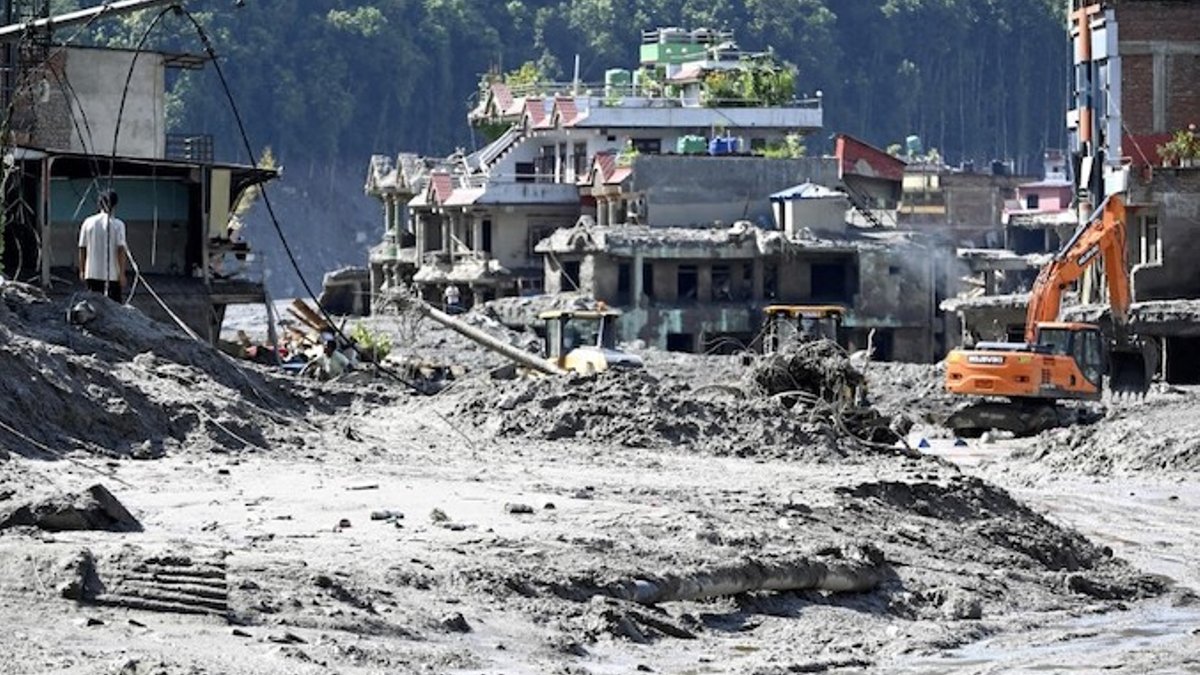
The collapse of a glacial lake high in the Himalayas early Wednesday has triggered a major disaster in Nepal, with officials now counting the cost of what experts describe as a direct consequence of global warming. The event, known as a Glacial Lake Outburst Flood, or GLOF, has already claimed more than 540 lives, and authorities fear the toll could surpass 2,000 given the number of people still unaccounted for in Nepal and China.
These floods occur when a glacial lake’s natural dam gives way.
Often made of ice or loose rock, it sends a wall of water and debris down mountain valleys. The rate of warming on the “roof of the world” is making such failures more likely, and scientists warn this is probably not the last one.
Red Cross reports widespread devastation
The International Federation of Red Cross and Red Crescent Societies (IFRC) said on Friday that early estimates suggest 93,000 people may have been affected by the flood. David Fisher, the federation’s head of delegation for Nepal, described the scale of the destruction from Kathmandu.
“Due to roads and bridges having been washed out and both cell coverage and electricity cuts, we have not yet been able to access some of the hardest-hit areas,” Fisher told a Geneva press conference.
“The trauma of this event is enormous.”
Thousands of homes have been destroyed or suffered significant damage.
Related: Millions of Teslas, Chinese EVs Recalled
The humanitarian response is complicated by the fact that many valleys remain cut off. What makes this particular event stand out is that it is not an isolated meteorological accident; it fits a broader pattern of intensifying climate-related crises across the region.
UN warns of ‘Super El Nino’ and food security risks
Beyond the immediate tragedy, UN agencies are now flagging further potential emergencies later this year. A group including the World Food Programme, OCHA, and the FAO issued a warning on Friday about the developing Super El Nino and the Indian Ocean Dipole.
These patterns could disrupt agriculture and supply chains.
“The latest forecasts point increasingly towards a very strong, and potentially exceptional, El Niño—it could rank among the strongest events in the historical record and may extend well into 2027,” the group stated.
The strength of the event alone will not determine its impact.
They noted that “what matters is where rainfall and temperature anomalies coincide with crop calendars, water scarcity, vulnerable livelihoods and limited coping capacity.”
The UN analysis suggests the combined impact of these climate patterns could push an additional 8.2 million people into acute food insecurity in Asia and the Pacific.
Related: Thai Fishery Abuses Exposed on Netflix Series
That would happen in a few monitored countries.
The countries identified as most at risk are Myanmar, the Philippines, East Timor, Papua New Guinea, the Solomon Islands, and Vanuatu. A second tier of nations at higher risk includes Afghanistan, Pakistan, Sri Lanka, Indonesia, Micronesia, the Marshall Islands, Nauru, Kiribati, and Tuvalu.
The warning also pointed to a cascading economic shock driven by what it calls the “three Fs”—fuel, fertilizer, and food—pressures that are being exacerbated by the crisis in the Middle East. “Urea prices more than doubled at their peak, while fuel and food prices remain high,” the warning noted, raising the risk that climate-related production losses translate into higher food insecurity in late 2026 and 2027.
The situation in the country is a stark reminder.
These are not abstract risks.
The flood waters have already demonstrated the destructive power of a warming atmosphere, and the window for preparing for the next event is closing faster than most governments are acting.


Leave a Reply