
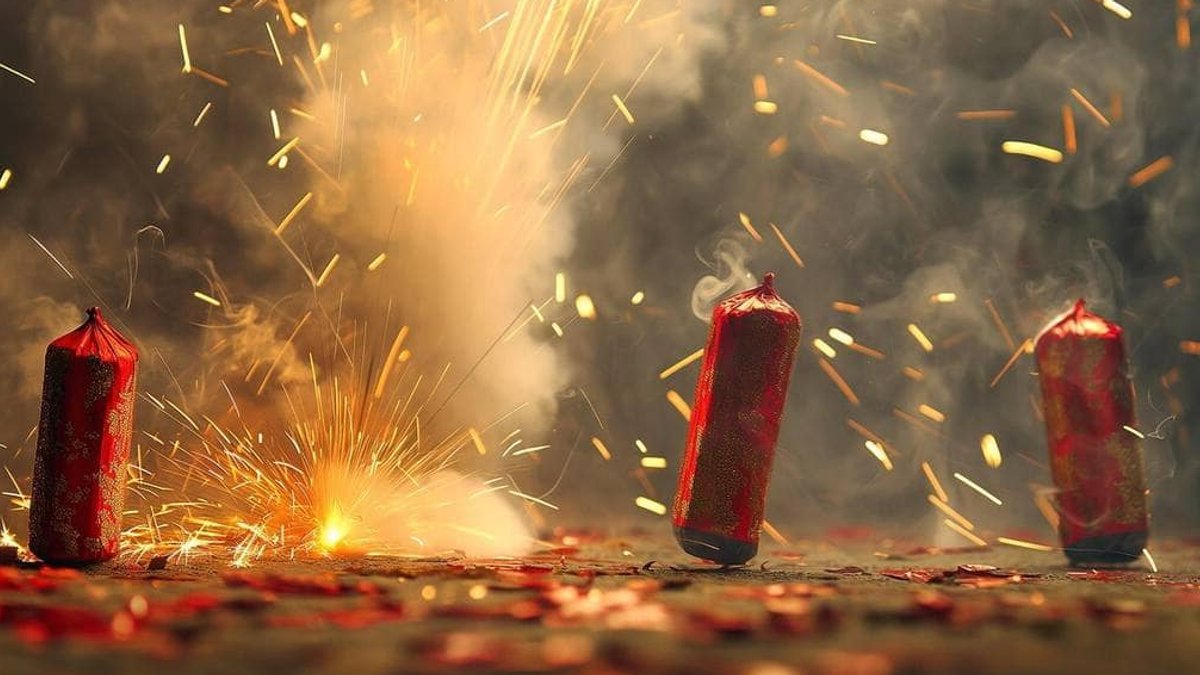
India’s fireworks industry generates an estimated ₹7,000 crore annually but remains almost entirely domestic, with exports below $1 million yearly. More than 99 per cent of India’s fireworks production is consumed domestically, leaving only a tiny fraction for overseas markets. The industry relies heavily on festivals like Diwali, with over 80 per cent of domestic revenue, or over ₹4,000 crore, generated during the 30-day period surrounding the festival. Despite this domestic strength, its global presence remains negligible compared to competitors.
The industry is centered in Sivakasi, Tamil Nadu, which accounts for roughly 85-90 per cent of the country’s total production. Annual turnover in the region is valued at around ₹7,000 crore, according to the Tamil Nadu Fireworks and Amorces Manufacturers Association (TANFAMA), with ₹2,000 crore from core manufacturing and ₹5,000 crore from distribution channels. India’s recorded fireworks exports stand at $757,000, giving the country just 0.042 per cent of the global export market, with leading destinations including Vietnam, Bulgaria, and the United States. China dominates the sector, with annual fireworks exports ranging between $1.1 billion and $1.23 billion.
China’s dominance is centered in Liuyang city, Hunan province, which accounts for roughly 60 per cent of China’s domestic supply and around 70 per cent of its global exports. Advantages include low-cost labor, access to raw materials, government support, and established global distribution networks. Generations of expertise have helped maintain competitive pricing and a wide product range. Dr. Biswajit Nag, professor of economics at the Indian Institute of Foreign Trade, notes that strong domestic demand and established distribution networks leave Indian manufacturers with little incentive to explore overseas markets, especially when local orders absorb production capacity. Exporting becomes attractive only when returns exceed those from domestic sales.
Regulatory and chemical barriers block exports
Regulatory barriers further hinder India’s export potential. This classification affects shipping costs, insurance premiums, and port clearances, adding complexity for smaller exporters lacking specialized infrastructure.
Chemical restrictions present another hurdle. The Supreme Court’s 2018 ban on barium nitrate, a key ingredient in nearly 80 per cent of global firecracker formulations, has affected manufacturers’ ability to produce formulations used internationally. While Western markets use alternatives like potassium perchlorate, Indian producers face restrictions on their use, making it difficult to meet overseas requirements.
Dr. Ajay Sahai, CEO of the Federation of Indian Export Organisations, highlights fragmentation as an obstacle. India’s fireworks sector is dominated by micro, small, and medium enterprises (MSMEs) that lack economies of scale. Their focus remains on domestic festivals, rather than global markets with stricter requirements. Without coordinated improvements in quality control, certification, and logistics, breaking into export markets remains difficult.
China’s standardized clusters outpace India’s fragmented MSMEs
The production gap extends beyond scale to operational systems. China’s industrial clusters benefit from standardized testing, global certifications, and reliable shipping networks, whereas India’s MSMEs often operate in isolation. This lack of coordination limits India’s ability to meet international standards.
The industry’s future depends on whether Sivakasi’s factories can transition from festival-driven production to global supply chains. Domestic demand ensures steady revenue, but exporting requires overcoming logistical and regulatory hurdles. The seasonal nature of the market further limits India’s ability to compete with China’s continuous, large-scale operations.
The path forward requires reconciling domestic priorities with export ambitions. India’s potential lies in niche markets where quality and innovation matter more than volume. Addressing regulatory and logistical barriers is the first step toward making exports viable for manufacturers.


Leave a Reply